English

Hello, friends in the engineering field!
In the field of mechanical rebar connections, straight thread couplers are undoubtedly the true “stars.” Although they may look like small components, they are directly related to the safety and integrity of an entire building structure.
Today, as someone who has spent many years working in this industry, I’d like to present a comprehensive classification guide to straight thread couplers. From materials to applications, I’ll explain all the main types in detail so that you can fully understand them.
What exactly is a straight thread coupler?
Simply put, it is a steel sleeve with internal threads. It connects two reinforcing bars by screwing onto the external threads processed at the ends of the rebars, thereby firmly joining them into a single continuous bar and ensuring effective load transfer.
Its core advantages include:
High strength
Stable and reliable quality
Fast and efficient installation
Compared with traditional methods such as welding or lap splicing, straight thread connections provide a more reliable and efficient solution.
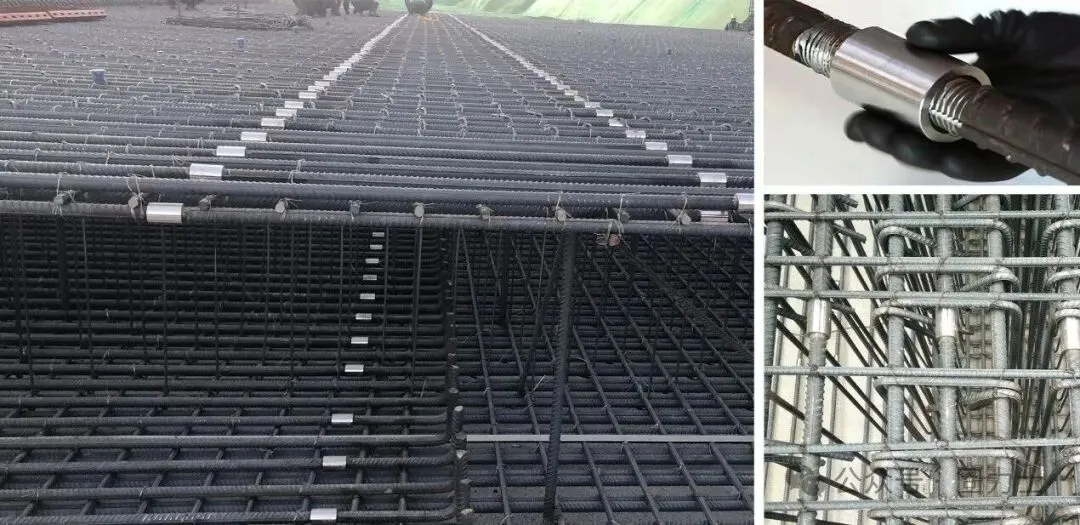
Core Classification of Straight Thread Couplers: By Processing Method
This is the most common classification method and also the key factor that determines the coupler’s performance and application scenarios. It mainly includes the following four types:
1. Direct Rolled Straight Thread Couplers
This is a relatively rough and early-stage process, essentially the first generation of mechanical rebar connections.
Process principle:
Threads are rolled directly onto the original rebar surface without removing the ribs.
Advantages:
Simple processing steps
High production efficiency
One-step forming
Relatively low equipment cost
Disadvantages:
Lower thread accuracy
Because rebars have ribs, uneven stress during rolling may lead to incomplete threads or damaged thread crests
Application scenarios:
Used in secondary structural components or temporary facilities where strength requirements are not very high. In modern projects, it has gradually been replaced by the rib-stripping rolling process.
Simple analogy:
It is like pressing footprints directly onto uneven rocky ground—the depth and shape of the footprints depend on the irregular surface.
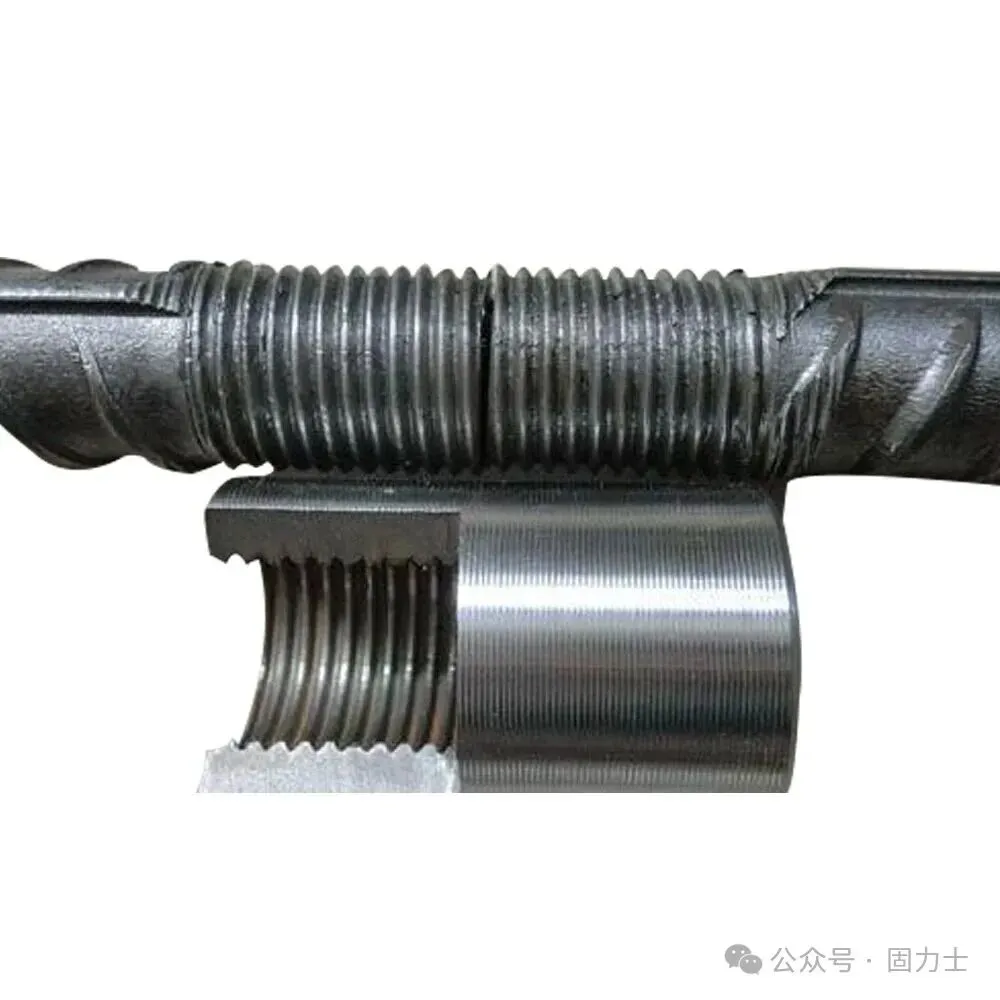
2. Rib-Stripped and Rolled Straight Thread Rebar Coupler
This is currently the most widely used type on the market and offers the best overall performance.
Process principle:
The transverse and longitudinal ribs at the end of the rebar are first removed, turning the surface into a smooth cylindrical shape, and then the threads are rolled.
Advantages:
High thread accuracy:
Removing the ribs ensures a consistent base diameter before rolling, resulting in full and precise thread profiles.
Stable connection quality:
The thread root diameter equals the nominal diameter of the rebar, providing stable strength that can reach the highest industry standard (Grade I joint).
Wide applicability:
It adapts well to different chemical compositions of rebars.
Disadvantages:
One additional processing step compared with direct rolling
Slightly more complex equipment
Application scenarios:
Used in almost all major construction projects, especially for critical load-bearing components such as beams, columns, and shear walls.
Simple analogy:
It is like sharpening a pencil—first shaving the wood to make it round, then sharpening the tip, resulting in a neat and precise point.
3. Upset Straight Thread Rebar Coupler
This is a clever process based on the principle of “increase first, then reduce.”
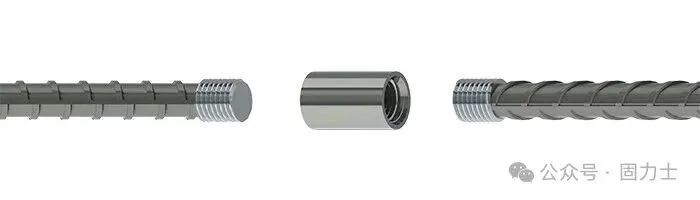
Process principle:
The end of the rebar is first cold-upset (forged) to increase its diameter beyond that of the base bar, and then threads are machined on the enlarged section.
Advantages:
Excellent strength reliability:
The thread root diameter is larger than the base rebar diameter, ensuring that the joint strength exceeds the strength of the rebar itself, making it a reliable Grade I joint solution.
Disadvantages:
Complex process and higher cost:
Requires specialized upsetting equipment and consumes more energy.
High ductility requirements:
The cold upsetting process requires rebars with good ductility; otherwise cracks may occur during upsetting.
Application scenarios:
Particularly suitable for:
Large-diameter rebars
Core shear walls and columns in high seismic zones
Connections at prestressed tendon anchorage ends
Simple analogy:
It is like melting the end of a rope into a knot before tying it, making the knot stronger than the rope itself.
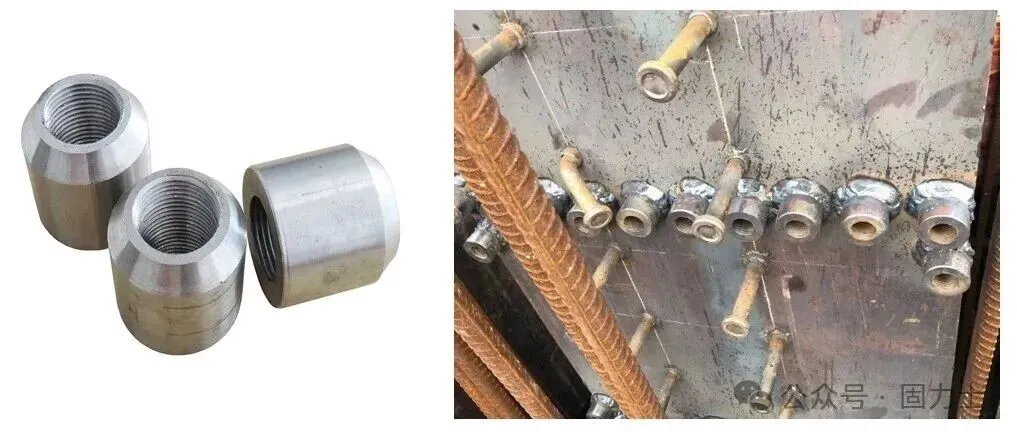
4. Weldable Straight Thread Couplers
This is a cross-functional solution that bridges the gap between mechanical connections and welding.
Process principle:
One end of the coupler has a standard straight thread for connecting rebars, while the other end is made with special materials and structural design, allowing it to be directly welded to steel plates or steel sections.
Advantages:
Seamless integration between steel and concrete structures:
It effectively solves connection problems between rebars and steel structural elements such as embedded plates and steel column bases.
Convenient construction:
Faster and more controllable than traditional methods like plug welding through drilled steel plates.
Disadvantages:
Requires couplers with qualified welding performance
Depends on proper welding skills and procedures
Application scenarios:
Composite steel structures
Embedded parts in reinforced concrete structures
Connections between precast components and steel plates in prefabricated buildings
Other Important Classification Dimensions
In addition to processing technology, couplers can also be classified from other perspectives:
By connection type:
Standard Type
The most common type, used for connecting rebars of the same diameter.
Reducing Type
Used for connecting rebars with different diameters.
Left-and-Right Thread Type
Designed for situations where the rebars cannot rotate. The connection is achieved by rotating the coupler itself, often used for bent rebars or rebars passing through columns.