

Professional Rebar Coupler Manufacturer — Shenzhen Gulis Building Materials Co., Ltd.


Failure Modes of Rebar Mechanical Joints & On-Site Judgment Methods

2026-07-13Visits:

Failure Modes of Rebar Mechanical Joints & On-Site Judgment Methods

01. Why Must You Understand Joint Failure Modes?

In rebar mechanical splicing, many people focus only on price and specifications but overlook the core question:

👉 How does the joint actually "fail"?

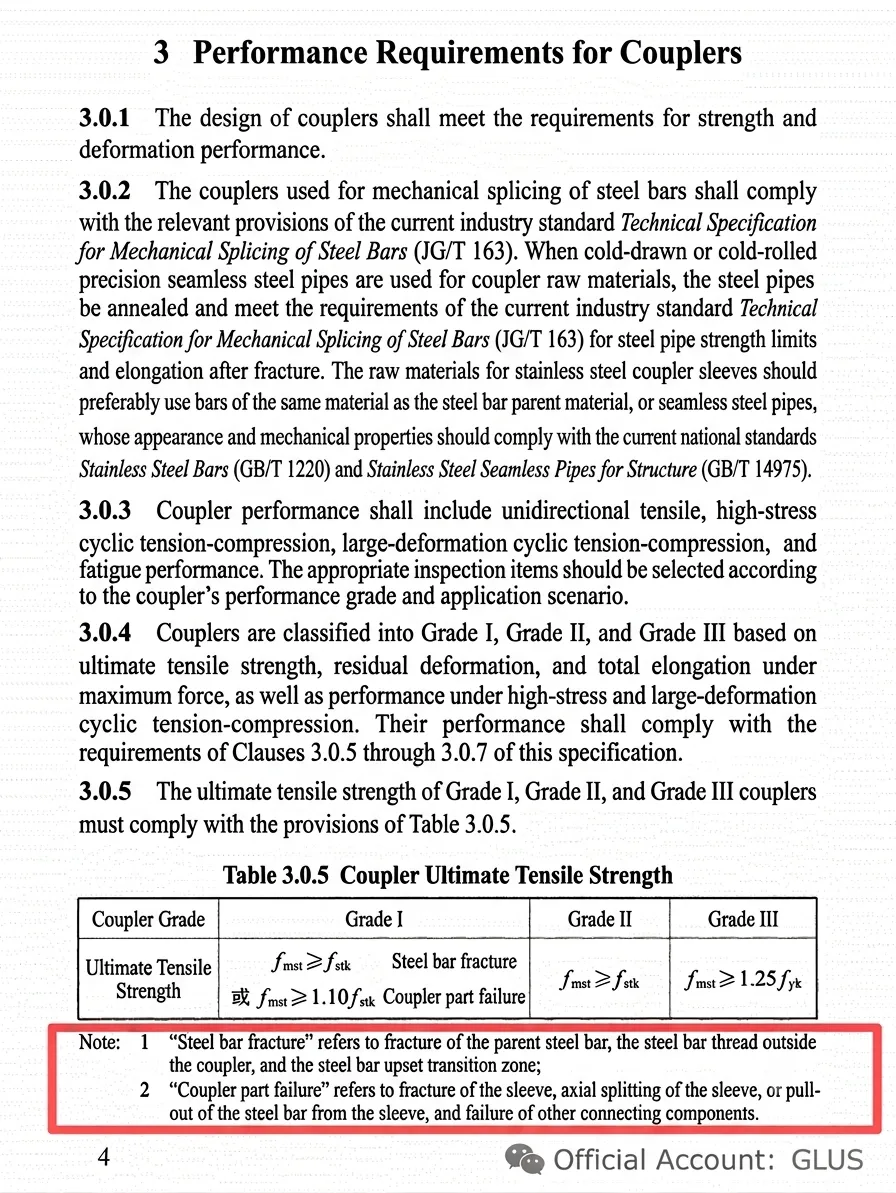
In reality, there is only one ultimate standard for judging engineering quality: Joint Strength ≥Parent Metal Strength

According to the Technical Specification for Mechanical Splicing of Rebars (JGJ 107-2016): The design principle requires the joint strength to be higher than that of the parent metal, meaning failure should occur in the parent metal.

  • Qualified Joint: Failure should preferentially occur as parent metal breakage.

  • Quality Risk: If the failure occurs at the joint or via slipping, it indicates a quality defect.
6ba34b6dfe814c1d8c02f065ea8fc20a.png


02. The Three Core Failure Modes

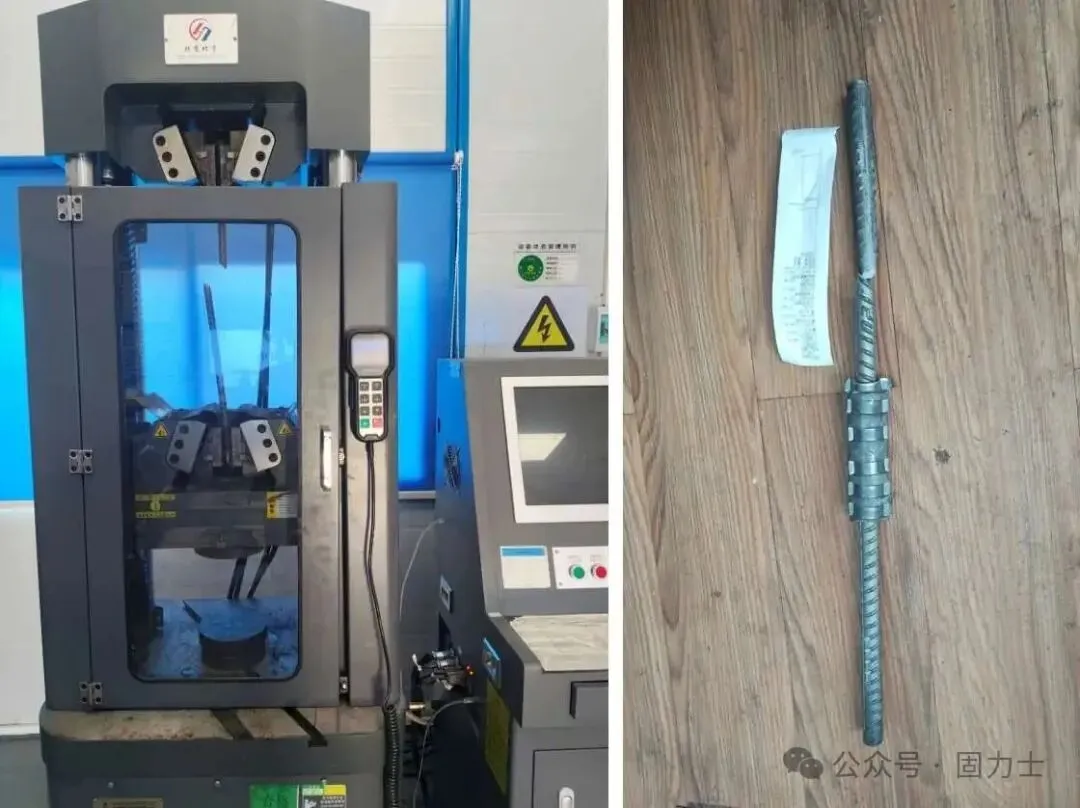
1️⃣ Parent Metal Failure (The Ideal State)

  • 👉 Appearance: * Fracture occurs far away from the coupler.

    • The rebar shows obvious necking.

    • The joint area remains completely intact.

  • 👉 Indication:

    • ✔ The joint strength is higher than the rebar itself.

    • ✔ Fully complies with code specifications.

  • 👉 Takeaway: The structure is safest when the joint remains "invisible" under ultimate load.
微信图片_2026-07-13_155219_273.jpg


2️⃣ Joint Failure (Typical Quality Issue)

  • 👉 Appearance:

    • Fracture occurs right at the coupler or the threaded end.

    • Visible damage at the splice location.

  • 👉 Common Causes:

    • Substandard thread processing.

    • Insufficient material strength of the coupler.

    • Incomplete tightening or poor installation.

    • Misalignment (not coaxial).

  • 👉 Engineering Judgment:

    • ❌ Deemed an unqualified joint.

    • ❌ Must be reworked or replaced.

3️⃣ Slip Failure (The Most Hidden & Dangerous)

  • 👉 Appearance:

    • The rebar does not break.

    • It is pulled out of the coupler.

    • The slippage/displacement exceeds the allowable limit.

  • 👉 Cause Analysis:

    • Insufficient thread length.

    • Tightening torque fails to meet the standard.

    • Poor thread precision.

  • 👉 Risks:

    • ⚠ Insufficient load-bearing capacity.

    • ⚠ Extremely difficult to detect with the naked eye on-site.

03. 5 Specific Common Failures in the Field

Beyond the three main categories, the following specific issues are frequently encountered on-site:

  • 1️⃣ Threaded End Breakage------- Severe weakening during the thread-cutting/rolling process.

  • 2️⃣ Coupler Cracking ------- Substandard material or insufficient wall thickness.

  • 3️⃣ Thread Shear Failure -------Stripping due to poor engagement between internal and external threads.

  • 4️⃣ Joint Loosening -------Torque did not meet the standard, or failure occurred under vibration environments.

  • 5️⃣ Eccentric Loading Fracture------- Misalignment during installation leading to stress concentration.

04. How to Quickly Judge Joint Quality On-Site?

Here is a simple and practical field formula:

"Check the break point, check the necking, check the slip."

  • Breaks at the rebar -------Qualified

  • Breaks at the joint------- High Risk

  • Pulled out------- Critical Danger

05. Why Do Premium Joints Always Aim for "Parent Metal Failure"?

The fundamental reason is simple:

👉 To make the joint "disappear" within the structure.

This means the joint:

  • Matches or exceeds the strength of the rebar.

  • Shares identical mechanical performance.

  • Does not become a weak point in the structural chain.

06. How to Prevent Joint Failure?

To consistently achieve "parent metal failure" in actual projects, four critical steps must be strictly controlled:

  • Precision Rolling Process -------Ensures the threaded end's strength is not compromised.

  • High-Strength Alloy Steel Couplers -------issues completely.

  • 100% Factory Inspection Mechanism------- Guarantees consistency and stability.

📊 Summary (Perfect for Sharing)

Rebar splicing looks simple, but it is a critical node for structural safety.

A truly premium mechanical joint has only one standard:

👉 Break the rebar, don't break the joint.


Leave Your Message

Leave a message

We use cookie to improve your online experience. By continuing to browse this website, you agree to our use of cookie.

Cookies

Please read our Terms and Conditions and this Policy before accessing or using our Services. If you cannot agree with this Policy or the Terms and Conditions, please do not access or use our Services. If you are located in a jurisdiction outside the European Economic Area, by using our Services, you accept the Terms and Conditions and accept our privacy practices described in this Policy.
We may modify this Policy at any time, without prior notice, and changes may apply to any Personal Information we already hold about you, as well as any new Personal Information collected after the Policy is modified. If we make changes, we will notify you by revising the date at the top of this Policy. We will provide you with advanced notice if we make any material changes to how we collect, use or disclose your Personal Information that impact your rights under this Policy. If you are located in a jurisdiction other than the European Economic Area, the United Kingdom or Switzerland (collectively “European Countries”), your continued access or use of our Services after receiving the notice of changes, constitutes your acknowledgement that you accept the updated Policy. In addition, we may provide you with real time disclosures or additional information about the Personal Information handling practices of specific parts of our Services. Such notices may supplement this Policy or provide you with additional choices about how we process your Personal Information.


Cookies

Cookies are small text files stored on your device when you access most Websites on the internet or open certain emails. Among other things, Cookies allow a Website to recognize your device and remember if you've been to the Website before. Examples of information collected by Cookies include your browser type and the address of the Website from which you arrived at our Website as well as IP address and clickstream behavior (that is the pages you view and the links you click).We use the term cookie to refer to Cookies and technologies that perform a similar function to Cookies (e.g., tags, pixels, web beacons, etc.). Cookies can be read by the originating Website on each subsequent visit and by any other Website that recognizes the cookie. The Website uses Cookies in order to make the Website easier to use, to support a better user experience, including the provision of information and functionality to you, as well as to provide us with information about how the Website is used so that we can make sure it is as up to date, relevant, and error free as we can. Cookies on the Website We use Cookies to personalize your experience when you visit the Site, uniquely identify your computer for security purposes, and enable us and our third-party service providers to serve ads on our behalf across the internet.

We classify Cookies in the following categories:
 ●  Strictly Necessary Cookies
 ●  Performance Cookies
 ●  Functional Cookies
 ●  Targeting Cookies


Cookie List
A cookie is a small piece of data (text file) that a website – when visited by a user – asks your browser to store on your device in order to remember information about you, such as your language preference or login information. Those cookies are set by us and called first-party cookies. We also use third-party cookies – which are cookies from a domain different than the domain of the website you are visiting – for our advertising and marketing efforts. More specifically, we use cookies and other tracking technologies for the following purposes:

Strictly Necessary Cookies
These cookies are necessary for the website to function and cannot be switched off in our systems. They are usually only set in response to actions made by you which amount to a request for services, such as setting your privacy preferences, logging in or filling in forms. You can set your browser to block or alert you about these cookies, but some parts of the site will not then work. These cookies do not store any personally identifiable information.

Functional Cookies
These cookies enable the website to provide enhanced functionality and personalisation. They may be set by us or by third party providers whose services we have added to our pages. If you do not allow these cookies then some or all of these services may not function properly.

Performance Cookies
These cookies allow us to count visits and traffic sources so we can measure and improve the performance of our site. They help us to know which pages are the most and least popular and see how visitors move around the site. All information these cookies collect is aggregated and therefore anonymous. If you do not allow these cookies we will not know when you have visited our site, and will not be able to monitor its performance.

Targeting Cookies
These cookies may be set through our site by our advertising partners. They may be used by those companies to build a profile of your interests and show you relevant adverts on other sites. They do not store directly personal information, but are based on uniquely identifying your browser and internet device. If you do not allow these cookies, you will experience less targeted advertising.

How To Turn Off Cookies
You can choose to restrict or block Cookies through your browser settings at any time. Please note that certain Cookies may be set as soon as you visit the Website, but you can remove them using your browser settings. However, please be aware that restricting or blocking Cookies set on the Website may impact the functionality or performance of the Website or prevent you from using certain services provided through the Website. It will also affect our ability to update the Website to cater for user preferences and improve performance. Cookies within Mobile Applications

We only use Strictly Necessary Cookies on our mobile applications. These Cookies are critical to the functionality of our applications, so if you block or delete these Cookies you may not be able to use the application. These Cookies are not shared with any other application on your mobile device. We never use the Cookies from the mobile application to store personal information about you.

If you have questions or concerns regarding any information in this Privacy Policy, please contact us by email at . You can also contact us via our customer service at our Site.