English

Dubai’s construction sector continues to set global benchmarks for high-rise engineering, complex foundations, and fast-paced infrastructure delivery. As buildings grow taller and structural loads become more demanding, traditional lap splicing often fails to meet the technical, safety, and spatial requirements of these mega-projects.
For B2B buyers—contractors, distributors, procurement managers, and wholesalers—understanding mechanical splicing systems is now essential. Whether supplying rebar for raft foundations, core walls, or superstructure columns, knowing the coupler standards and approvals required in the UAE market directly affects project compliance, installation efficiency, and overall structural performance.
In a market where precision, traceability, and time-critical construction are the norm, choosing the right mechanical splice system is no longer optional—it is a strategic advantage.
This guide provides UAE buyers with a practical overview of standards, mechanical requirements, approval processes, and product selection for mechanical couplers in reinforced concrete.
Key Standards Governing Mechanical Splices in Dubai & the UAE
Mechanical splicing systems in the UAE are regulated through a combination of international standards and local compliance frameworks. B2B buyers must ensure that all couplers meet these requirements before use in any Dubai project.
ISO 15835-1 / ISO 15835-2 (International Standard for Mechanical Splices)
The globally recognized reference for couplers used in reinforced concrete.
ISO 15835 specifies:
Requirements for coupler design and performance
Tensile and compression strength criteria
Cyclic (fatigue) behavior for high-demand structures
Manufacturing tolerances and quality assurance
On-site installation and inspection guidelines
Dubai consultants and regulatory authorities commonly refer to ISO 15835 for coupler acceptance.
BS 8110 & BS 4449 (Relevant to Rebar Used With the Coupler System)
While primarily rebar standards, they are relevant because:
The coupler must match the mechanical properties of the rebar
Threads must be compatible with designated grades
Material ductility and chemical composition affect splicing performance
Dubai Municipality (DM) Construction Specifications
DM reviews:
Coupler test reports
Tensile failure mode requirements
On-site threading/installation procedures
Batch traceability and compliance documents
ESMA / ECAS Certification (Mandatory for the UAE Market)
For mechanical splices imported into the UAE, the system must meet:
ESMA product conformity
Factory inspection requirements
Shipment documentation and traceability
Without ECAS approval, mechanical couplers cannot pass customs clearance or consultant approval.
Why These Standards Matter for B2B Buyers in Dubai
Prevents rejection during consultant inspections
Ensures compatibility with local and international project specifications
Protects against failure in high-stress structural zones
Supports better negotiation with mills and manufacturers
Ensures smooth ESMA/DM approval and customs clearance
Reduces structural risk in high-rise and infrastructure projects
Mechanical Performance Requirements for Couplers in UAE Projects
To pass consultant approval and site inspections, mechanical splices used in Dubai must demonstrate specific properties.
Tensile Strength
A compliant coupler must achieve:
≥125% of the specified yield strength of the rebar
Failure must occur in the rebar, not in the coupler itself
This is crucial for safety and long-term performance.
Ductility & Cyclic Performance
Required for:
Seismic-design zones
Tower cores
Raft and pile caps
Couplers must maintain performance under repeated loading cycles.
Fatigue Resistance
Important for:
Bridges
Metro lines
Industrial structures
Systems must withstand long-term stress variation.
Thread Quality and Precision
Threads must be:
Uniform
Full-depth
Free from defects
Poorly formed threads can compromise load transfer and cause failure.
Installation Efficiency
Contractors in the UAE prioritize coupler systems that:
Require minimal labor
Ensure consistent on-site performance
Reduce congestion in highly reinforced elements
Documentation Required for Mechanical Coupler Imports into Dubai
To avoid delays at Jebel Ali, Khalifa Port, or during consultant audits, suppliers must provide:
1. Manufacturer’s Test Certificate (MTC)
Includes:
Chemical composition
Tensile results
Cyclic/fatigue results
Thread accuracy data
Batch/heat number traceability
2. ISO 15835 Compliance Certificates
3. ECAS Certificate (Mandatory for UAE Market)
4. Certificate of Origin (COO)
5. Commercial Invoice & Packing List
Must clearly state:
Coupler size range
Standard used
System type (parallel-threaded, cold-forged, upset, etc.)
6. Third-Party Test Reports (If Required by Consultant)
Issued by accredited international testing bodies.
Clear documentation ensures faster project approval and eliminates compliance disputes.
Common Types of Mechanical Splices Used in Dubai
Parallel Threaded Couplers
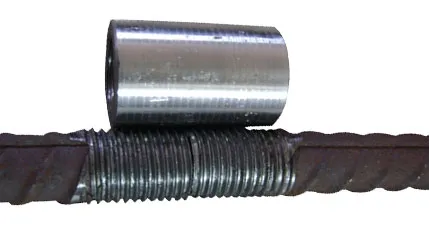
Most widely used in high-rise towers.
Straight-cut threads
Consistent installation
High structural reliability
Upset Forged-End Couplers
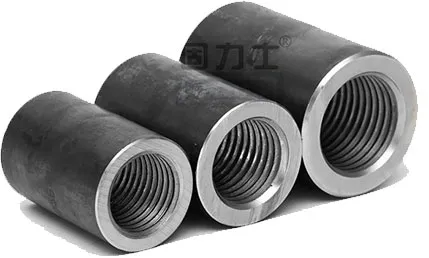
Ideal for:
High-stress zones
Rebars requiring full-strength performance
Position Couplers
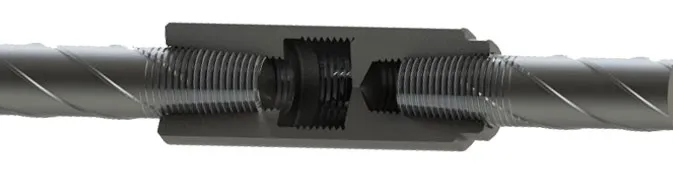
Used when:
Two bars cannot rotate
Retrofitting or replacement is required
Transitional Couplers
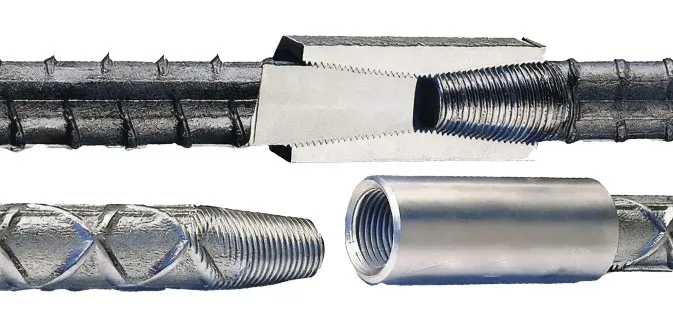
Connect rebars of different diameters.
Where Mechanical Couplers Are Used in UAE Projects
Mechanical splicing is now standard for:
High-rise columns & core walls
Raft foundations & pile caps
Transfer beams
Mega-infrastructure projects
Congested reinforcement zones
Seismic load regions
Projects requiring minimal lap length
Mechanical couplers help reduce rebar congestion, improve alignment, and enhance structural continuity—key advantages for Dubai’s dense, complex construction environment.