English

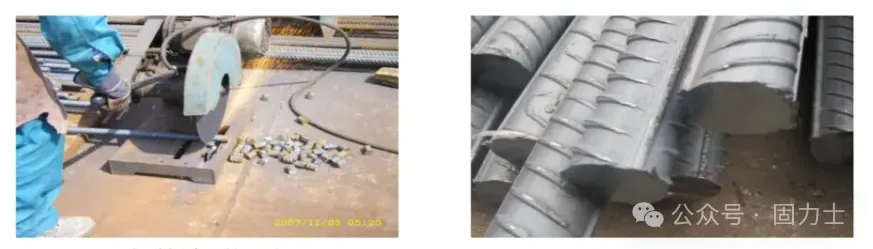
Potential Quality Risks:
- Substandard material: The strength and ductility of the coupler material fail to meet standard requirements.
- Dimensional deviations: Internal thread size, tolerance, and length do not comply with specifications, resulting in overly tight or loose fitting with the thread end.
- Damage during transportation and storage: Thread damage caused by impact during transport, or corrosion due to humid environments.
Control Measures:
- Conduct strict inspection upon delivery, verifying certificates of conformity and test reports; perform sampling tests on mechanical properties when necessary.
- Use go/no-go gauges to check the accuracy of internal threads; reject any non-conforming batches.
- Store couplers off the ground with moisture protection; stacking height should not exceed 1.5 m to prevent deformation from excessive load.
III. Common Issues in Connection Operations and Standard Practices
Typical Operational Errors:
- Improper torque control:
- Insufficient torque: Tightening by feel without using a calibrated torque wrench, leading to “false tightening” and structural safety risks.
- Excessive torque: Over-tightening causes thread seizure, stripping, or deformation of the coupler and rebar.
- Incomplete connection: Exposed threads exceed allowable limits, resulting in insufficient effective connection length.
- Poor alignment: Axial misalignment or angular deviation between rebars introduces Extra stress.
- Missed or incorrect tightening: In congested reinforcement areas or during night work, connections may be missed or incorrectly tightened.
Standard Operation Guidelines:
- Always use a calibrated torque wrench and set torque values according to rebar diameter (e.g., Φ25 rebar corresponds to 260 N·m). Tighten until a “click” sound is heard.
- Clean debris from thread ends and inside the coupler before connection. After tightening, mark the junction between the coupler and rebar; exposed threads should be limited to 1–2 pitches.
Use rebar positioning brackets to ensure alignment; adjust immediately if deviation exceeds 3 mm.
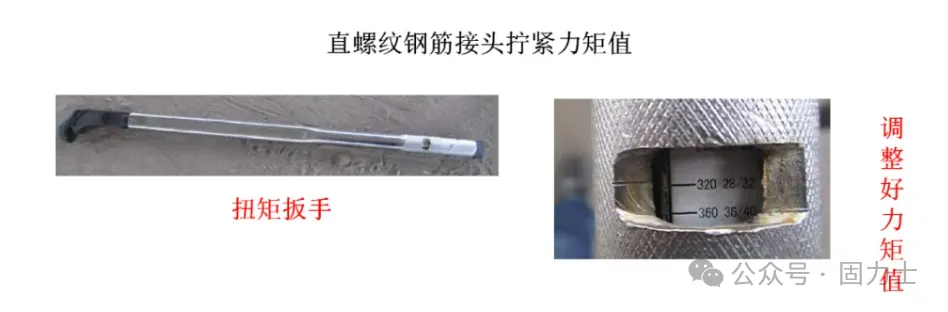
IV. On-Site Management Gaps and Optimization
Key Challenges:
- Insufficient worker skills, unfamiliarity with technical requirements, and lack of responsibility.
- Superficial technical briefings without clearly defined operational points and quality standards.
- Lack of process supervision, especially in critical steps such as thread processing and torque control.
- Disorganized material management, including poor inspection and improper storage leading to misuse or damage.
Optimization Measures:
- Provide specialized training before construction; only qualified personnel may operate. Implement “dual inspection” for critical procedures.
- Use illustrated technical briefings to clearly specify torque values and procedures for different rebar diameters.
- Establish a three-level record system (“processing–connection–inspection”), with a sampling inspection rate of no less than 10% per batch.
- Store couplers and protective caps by category with clear labeling, and apply a first-in, first-out (FIFO) system.
V. Strategies for Environmental and Spatial Constraints
Challenges in Special Conditions:
- Adverse weather: Rain or snow causes moisture and rust on threads; low temperatures reduce operational flexibility.
- Confined spaces: In beam-column joints or shear walls, dense reinforcement makes it difficult to apply torque.
- Work at height: Increases operational difficulty and safety risks, leading to non-standard connections.
Solutions:
- Suspend outdoor work during rain or snow; cover processed thread ends with waterproof sheets and dry threads with a hot air gun before resuming work.
- Use short-handle torque wrenches in dense reinforcement areas, or optimize rebar layout in advance to reserve working space.
- For high-altitude work, set up stable platforms and secure tools with fall-prevention devices to avoid one-handed operation.
VI. Technical Points for Special Rebar Connections
- Different-diameter rebar connection:
Use matched reducing couplers to ensure compatibility between thread specifications and rebar diameters. Tighten the smaller-diameter end first, then secure the larger end; apply torque based on the larger diameter standard. - High-strength rebar treatment:
For high-strength rebars with poor weldability, increase cutting fluid concentration during threading to reduce processing temperature. After processing, conduct hardness testing to prevent brittle fracture due to work hardening.
Summary: Key Control Points
Quality control of straight thread rebar coupler connections should focus on three critical aspects:
- Thread quality: Ensure precision in thread processing and proper protection of both thread ends and couplers.
- Torque control: Every connection must be tightened using a calibrated torque wrench strictly according to standard values.
- Process management: Establish a full traceability system from material entry to final inspection.
Through a closed-loop management approach of strict material inspection, equipment calibration, standardized operations, and process monitoring, the connection qualification rate can be increased to over 98%, providing a solid guarantee for structural safety.