English

GLUS Rebar Coupler Steel Mark Decoded:
Recognize the Marking — Ensure Reliable Quality
In construction projects, rebar couplers are the critical link connecting reinforcing bars. But have you ever paid attention to the small steel marking stamped on the coupler?
That seemingly minor imprint is actually the coupler’s core identity card. Without it, the product is non-compliant. If you can’t read it, you may not be able to verify its quality.
For GLUS rebar couplers, the steel marking is not just a random stamp. It strictly complies with the Chinese industry standard JG/T 163-2013, serving as both:
A quality credential of the brand
A mandatory inspection reference during project acceptance
Today, let’s break down why GLUS steel markings matter — and what each character represents.
01
GLUS Steel Marking: More Than Compliance — A Quality Commitment
Like all qualified couplers, GLUS markings are mandatory under JG/T 163-2013. However, GLUS integrates additional brand-level traceability and precision identification.
Its core value lies in two key aspects:
1️⃣ Error Prevention: Accurate Rebar Matching
On construction sites, couplers may look nearly identical — for example:
Ø25 mm vs Ø28 mm
Grade 400 vs Grade 500
Visually, they are difficult to distinguish. But the steel marking makes the difference clear:
“4 25” → Suitable for HRB400E Grade, Ø25 mm rebar
“5 28” → Suitable for HRB500E Grade, Ø28 mm rebar
GLUS couplers are precisely calibrated for strength compatibility.
Using a Grade 400 coupler for Grade 500 rebar — even if both are brand products — may create hidden fracture risks due to strength mismatch.
The steel marking is your first line of defense against improper use.
2️⃣ Full Traceability: GLUS Exclusive Coding System
If issues such as insufficient thread precision occur, simply locate:
The manufacturer identification code
The production batch number
With this information, GLUS after-sales service can retrieve:
Raw material inspection reports
Production records
Quality control documentation
This is the foundation of GLUS’s commitment to full-process traceability.
02
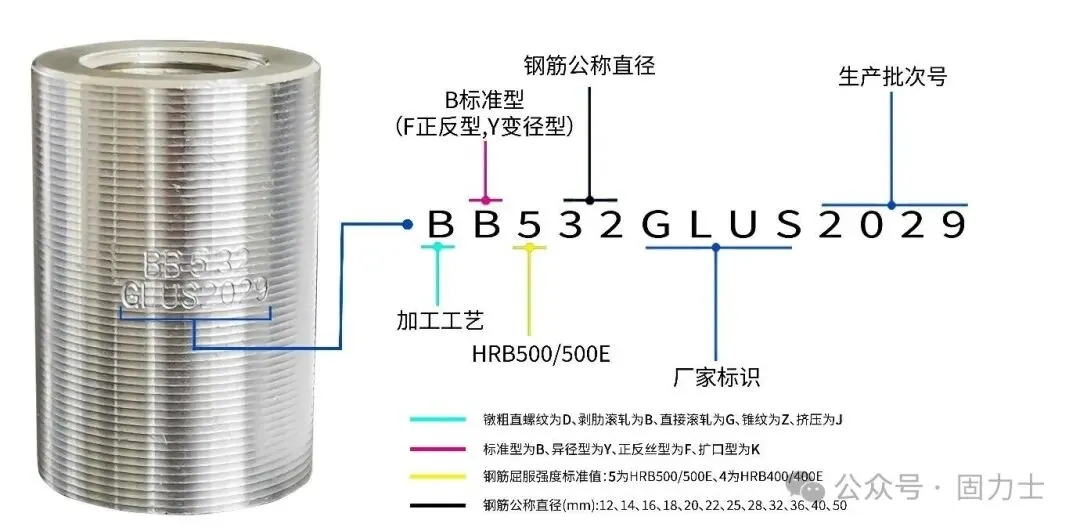
How to Read a GLUS Steel Marking
GLUS steel markings follow a structured logic:
Process Code + Type Code + Strength Code + Diameter Code + GLUS (Manufacturer ID) + Batch Number
Below is a practical decoding reference:
| Element | Meaning | Common GLUS Codes |
|---|---|---|
| Process Code | Coupler manufacturing process | B = Rib-stripping rolling; D = Upsetting; G = Direct rolling; J = Extrusion |
| Type Code | Coupler application type | B = Standard; Y = Reducer; F = Positive & Negative Thread; H = Weldable |
| Strength Code | Applicable rebar yield strength | “4” ≥400 MPa (HRB400/HRB400E); “5” ≥500 MPa (HRB500/HRB500E) |
| Diameter Code | Nominal rebar diameter (mm) | 16, 22, 25, etc.; Reducer type marked as small/large (e.g., 22/25) |
| Manufacturer ID + Batch | GLUS identification + production batch | GLUS + 2029 |
The presence of “GLUS” is the key authentication indicator.
03
Practical Example: Decoding a GLUS Marking
Example Steel Marking:
BB4 25 GLUS2029
Breakdown:
B → Rib-stripping rolling process
B → Standard type
4 → Grade 400 strength
25 → Ø25 mm rebar
GLUS → Manufacturer identification
2029 → Production batch number
Conclusion:
This is a rib-stripping rolled standard coupler, suitable for Grade 400 Ø25 mm rebar, produced under batch number 2029.
Final Thoughts
The steel marking on a rebar coupler may seem small — but it is a crucial safeguard for structural safety.
From preventing misuse to enabling full traceability, each character carries responsibility.
Manufacturers must strictly comply with marking standards, and construction teams should carefully verify markings during procurement and inspection.
✔ Pro Tip
Save this guide.
Next time you purchase or inspect rebar couplers, check each marking element carefully — and let the steel stamp become your on-site quality verification tool.